
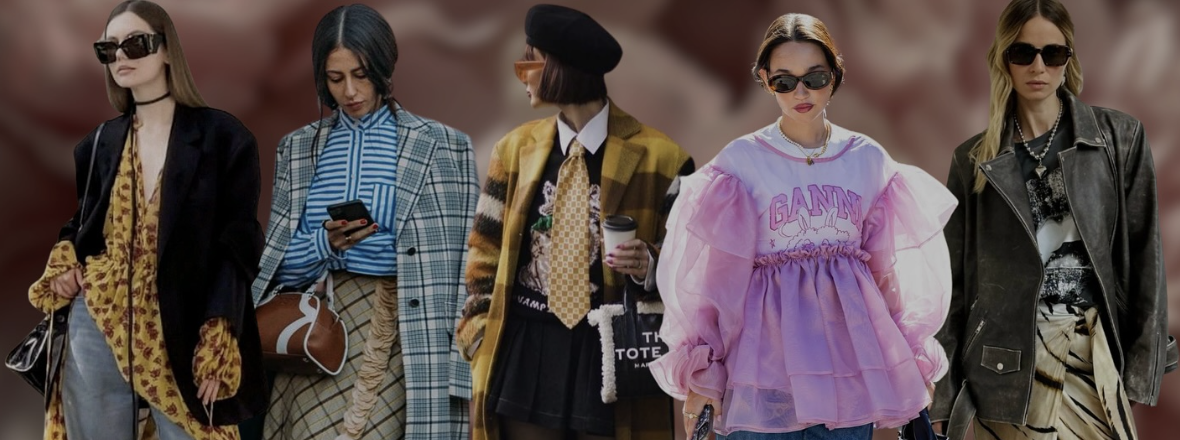
For the better part of a decade, the fashion world was held captive by the clean girl aesthetic and the sterile halls of quiet luxury. It was an era defined by beige, linen, $500 white t-shirts, and a terrifyingly disciplined commitment to doing the absolute least. However, if you look at any runway in 2026, the message is loud and clear; minimalism is dead.
The shift wasn’t a quiet exit, it was a hostile takeover. After years of sensory deprivation in our wardrobes, the pendulum has swung to a completely opposite space toward maximalism with a vengeance. We are no longer dressing to disappear into a neutral-toned background. We are dressing to take up space; both physically and visually.
The death of minimalism began with the rise of cluttercore and the rejection of the capsule wardrobe. This idea that a human being can exist within the confines of ten essential pieces has been revealed for what it always was a joyless exercise in marketing. Today’s trendsetters are embracing what stylists called radical expressionism.
Cluttercore is showing the return to clashing textures, or pairing heavy brocades with delicate lace and synthetic neons. It also includes the sentimental silhouette, which showcase charms, trinkets, and “ugly” heirlooms pinned to high-fashion garments. And, most importantly, layering; skirts over trousers, hoodies under corsets, and the abandonment of flattering proportions.
Economically, minimalism often thrives in times of extreme uncertainty or as a badge of stealth wealth. However, the current cultural mood is one of defiant hedonism. When the world feels chaotic, dressing like a mannequin doesn’t offer comfort anymore it feels like surrender to fallacies.
Quiet luxury was ultimately outed as exclusionary and, frankly, a bit boring. As the fashion cycle accelerated, the beige aesthetic became too easy to replicate by fast-fashion giants such as H&M or Pacsun, stripping it of its status, Not to say these brands aren’t just as valuable as a Hermes or a Lowe, but the accessibility to the style causes an over-saturation.
In response, the avant-garde has moved toward items that are impossible to mass-produce: hand-beaded jackets, vintage upcycled patchworks, and complex, asymmetrical tailoring. We’ve entered the era of the peacock effect, where the goal is to be the most interesting person in the room, not the most tasteful. Brands such as Chrome Hearts, Y-3 and Balenciaga have been prime examples with their recent collections
Perhaps the biggest executioner of minimalism is the younger generation’s distaste for corporate uniformity. To Gen-Z, a neutral wardrobe looks less like sophistication and more like middle aged, corporate management. They have traded the beige aesthetic for “Old Money” and “Dandyism” styles that prioritize irony and storytelling over cleanliness. This move has been supported by brands such as Alo and Polo Ralph Lauren.
The fashion industry is notoriously cyclical, but this shift feels more permanent than a mere seasonal change. It represents a psychological break from the pressure of perfection. Minimalism demands a curated, curated life; maximalism allows for the mess that is constantly in our head due to the political and economic state of the world.
As we move through the mid-2020s, the “less is more” mantra has been officially retired. In its place is a new, chaotic, and vibrant philosophy: “if it’s not too much, it’s not enough.” The beige and brown era is over, and clearly, it’s about time we had something to look at again.