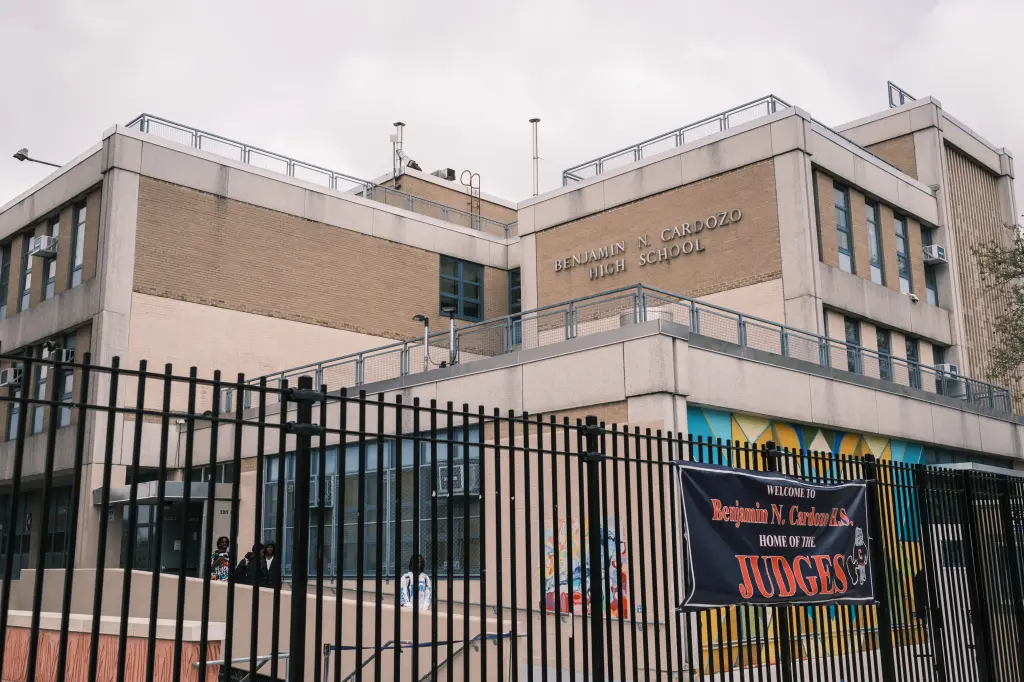
In April, Cardozo High School Principal Colby announced that the school’s designation was changed from a random scanning location to a permanent scanning school by the NYPD.
This change has been met with mixed emotions and reactions throughout the staff, students, and overall community. Despite the incident that occurred in the fall term where a student brought a loaded gun onto school grounds, many are still wondering why Cardozo was chosen as a permanent scanning location when there are a plethora of other schools in the New York City Department of Education that have a higher level of infractions.
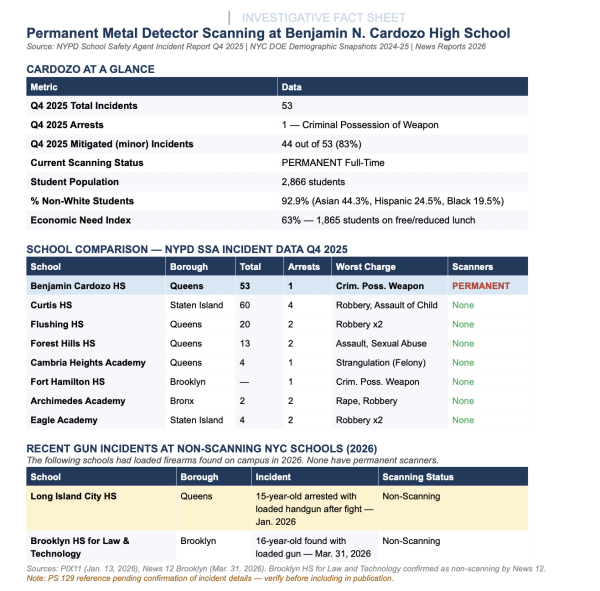
According to the NYPD’s own Q4 2025 School Safety Agent incident report, which tracks disciplinary infractions from September to December, there were a total of 53 incidents reported. Although there were 53 total incidents, 83% of those incidents were minor, which, in simplified terms, means that the issue was handled without police enforcement and instead, dealt with internally by school staff and the Office of Climate and Culture. There was only one incident that was designated as criminal possession of a weapon.
In contrast to the incident report for Cardozo, there are a multitude of schools that have a high number of incidents, and do not have permanent scanning. One example of this is Curtis High School in Staten Island, which had recorded 60 total incidents, including four arrests. These incidents included robbery, assault of a child, and two grand larceny charges. In comparison to Cardozo, Curtis High School had far more arrests.
In addition to Curtis High School, another school, Cambria Heights Academy in Queens, reported having a student arrested for felony strangulation. A felony is far more detrimental than a misdemeanor, and this can harm the school’s safety climate.
In addition Forest Hills High School in Queens had two arrests, which included assault and sexual abuse. Lastly, Fort Hamilton High School in Brooklyn had a student arrested for criminal possession of a weapon, the same charge that the student at Cardozo. Fort Hamilton High School is also not designated as a permanent scanning location.
Across the city, it is clear that there are a multitude of schools that have many arrests, disciplinary infractions, and internal issues that harms the school’s climate and safety. However, many of these buildings do not have any permanent scanners.
The citywide pattern does not stop there.
In January 2026, a 15-year-old at Long Island City High School in Queens was arrested because of possession of a loaded handgun following a fight that broke out on campus. Despite this, the NYPD has not made a move to designate Long Island City High School as a permanent scanning location. Furthermore, in March 2026, there was a student at Brooklyn High School for Law and Technology who was found with possession of a loaded gun on campus, but the school remains without any permanent scanning, as well.
This NYPD data opens the door to many questions, but one that remains at large: why was Cardozo selected as a permanent scanning school out of the various schools throughout the city with disciplinary infractions and arrests?
The inconsistent pattern at Cardozo is not random. Many researchers and civil liberties organizations have researched and documented some causes of why certain schools get permanent scanners over others.
A ProPublica investigation has shown that Black and Hispanic students are nearly three times more likely to go through metal detectors than white students. The New York Civil Liberties Union has also concluded that the NYPD’s criteria for installing scanners, both random and permanent, are primarily due to race.
Academic researcher Aaron Kupchik concurred that the strongest predictor for scanners is based on race. In contrast, 50% or more of students of color are 18 times more likely to have metal detectors than schools that have less than 20% students of color.
The student body of Cardozo is 92.9% non-white. In addition, the economic need index is 63%, which means that an overwhelming two-thirds of students are qualified for free and reduced lunch. Researchers have found that the biggest indicator for scanners is based on demographics and profile, rather than actual safety data.
Under Department of Education protocol, the NYPD safety division decides the final call for scanning, and if there are permanent scanners, depending on the urgency of the school’s safety climate. This essentially means that the school, including staff, UFT members, students, and others, can have an opinion, but can’t initiate the final vote for scanning.
We reached to NYC Council member Linda Lee, NYCP’s DCPI, and the DOE Press Office about the final decision to designate Cardozo as a scanning school, however, there were no responses to the inquiries made.
Beyond the data, the impact that scanning has on the school is large. Not only does it create issues for student arrival in the morning, it also costs the school a lot of money from the annual budget to staff each scanner. Furthermore, the NYCLU has documented that scanning can change the school’s climate and make students more criminalized and less trusted.
In the end, Cardozo High School will ensure that the proper safety measures are met with full transparency, but the question still remains: why Cardozo?