This article was originally published in the May 2026 print edition and later republished online to correct a misquote.
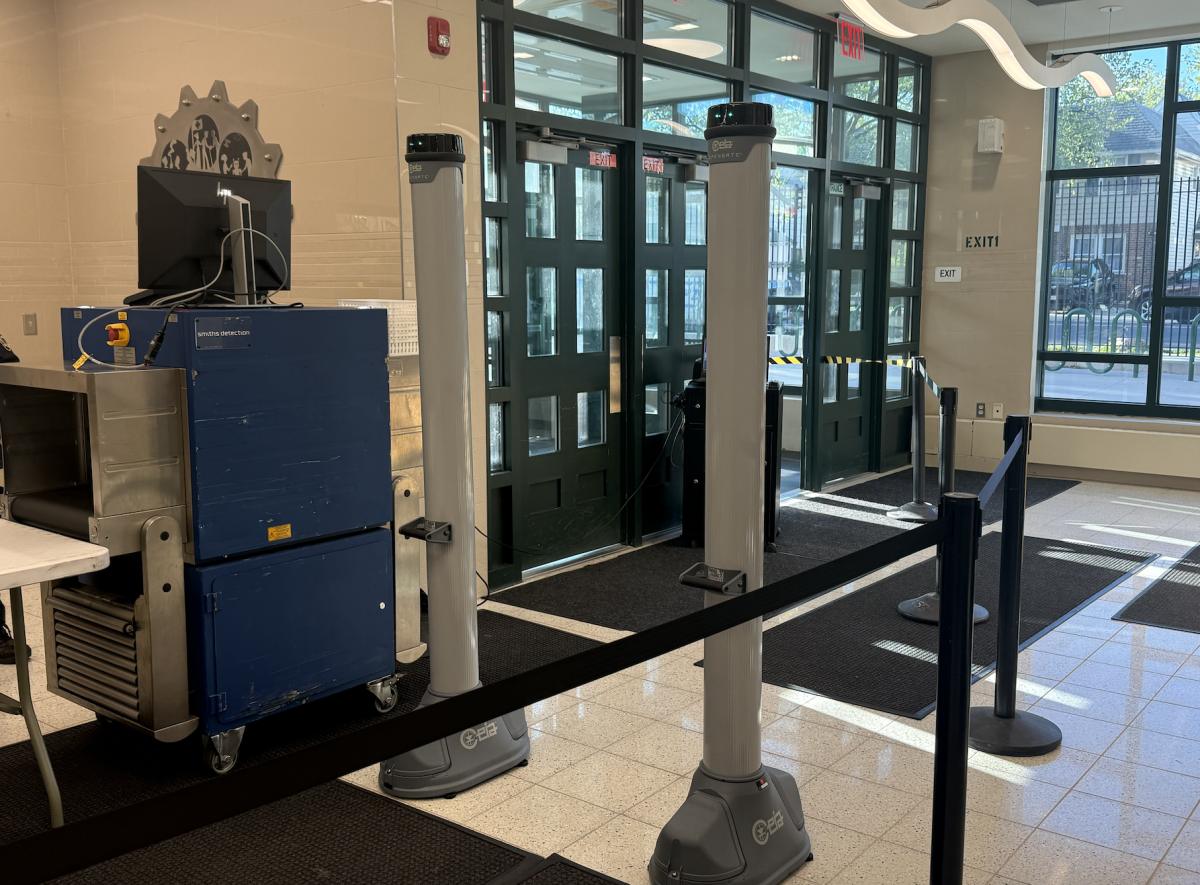
On April 22, Cardozo Principal Ms. Colby sent a school wide email announcing a major change taking place for the school community: Benjamin N. Cardozo High School has been designated a permanent scanning school by the New York City Police Department.
The announcement was one that did not surprise many school members, but a decision that sparked conversation throughout the entire Bayside community; even outside of Cardozo’s walls.
According to the NYPD and New York City Public School central staff, the decision was made based on incidents and safety concerns that happened at Cardozo High School, the most notable one taking place on Sept. 18, when a student brought a loaded handgun onto school grounds.
Although the incident was handled by Cardozo deans, in coordination with the NYPD, and no one on campus was impacted, the involvement of the FBI and media coverage sparked safety concerns and brought the story to the forefront of many news outlets. However, Cardozo is not the only school that has made headline news for disciplinary infractions in New York City Public Schools.
According to the NYPD School Safety Data for Q4 of 2025 (Sept-Dec), seven other high schools had disciplinary arrests from patrol officers, with Fort Hamilton High School in Brooklyn also being classified as criminal possession of a weapon. In addition, as of Jan. 2026, reports indicate that hand guns were found on students at Long Island City High School, Cambria Heights Academy, Brooklyn High School of Law and Technology, and Cascades High School.
Despite these statistics and reports, the NYPD’s decision was made final, according to Principal Colby, despite the SLT, or School Leadership Team, not coming to a complete vote on requesting scanning from the city.
“We didn’t request permanent scanning through the SLT,” Ms. Colby said. “The NYPD has the final vote. Whether people want it or not, this is our new normal, we have to make it our own.”
Mr. Sferrazza, the UFT Chapter Leader at Cardozo, shared that there was no consensus among the staff at all, and that no one from the Department of Education central office or school safety division addressed the staff to discuss concerns, either.
He added that he surveyed the Cardozo staff, and the results showed no clear majority.
“There are definitely mixed feelings on this issue,” he said. “Some are okay with it, some are opposed to it…there is no consensus.”
Mr. Sferrazza added that the union generally believes there should be consistent safety policies across the city rather than singling out individual schools.
Despite this, New York City Associate Press Secretary Isla Gething insists that all required engaging parties were consulted leading directly to mixed opinions and discussions with the SLT, teachers, SSA agents, parents, students, and the administration.
Ms. Millen, Assistant Principal of Climate and Culture and head of the Building Response Team, said she has no concerns or reservations with the new change.
“It’s an adjustment and we are ready to roll up our sleeves and do what we need to do to continue to ensure student safety,” she said.
Many of the Cardozo staff and students remain mixed on the decision to have permanent scanning in the building.
One of the concerns is that there are not enough scanners for the school building and the number of students required to go through them every day. Georgia Kalaitzaki , a junior, believes that the process is currently not working for students.
“I frankly think that it’s inefficient,” she said. “It’s not efficient to get in the building. If we had to become a permanent scanning school, then we would need more scanners.”
However, Principal Colby stated that despite requesting more equipment for the school, they have not been given any more from the NYPD. “I have requested additional setups to stay in the main lobby and was given what the NYPD will give us,” Ms. Colby said.
Ms. Millen added, “We have 4 scanning stations; that will be the maximum for our school.”
Many students’ concerns revolve around the amount of time it takes to get into the building due to scanning, and the added issue of mandatory school-issued electronic devices that must be removed from their bags upon getting to the scanners.
Sophomore Jiwoo Kim shared that the decision did not take any students’ concerns into account.
“Students have no say in this decision,” she stated. I understand they are trying to ensure safety, but there should also be consideration toward our grades, attendance, and the amount of time we lose.”
“I have an AP class first period, and when I’m late, it’s horrible for me,” Kalaitzaki added. “If you forget your ID, you miss the first period entirely.”
A freshman, who wished to remain anonymous, shared that they believe the scanners are beneficial, but there are some problems that arise because of them.
“The scanners are great for the safety of our school,” the student said. “However, many students may not arrive on time because of buses, traffic, or weather conditions.”
Staff members at Cardozo also remain divided on the new scanning designation. AP English teacher Ms. Krawec sympathized with students coming late due to circumstantial reasoning, but insisted that responsibility is a factor that students should optimize more.
“Students have told me that scanning has made them late,” she said. “But I also have many students who are consistently on time.” She added that she does not delay instruction due to scanning, stating that it isn’t fair to students who are on time for her to delay instruction.
In addition, Ms. Krawec emphasized that she always felt Cardozo was a safe place.
“I have always felt Cardozo was a safe place to be,” she said. “But the scanners do have the potential to discourage students from bringing prohibited items to school.”
Mr. Malekpour, social studies teacher and Civics for All teacher-leader, conceded that scanning has had a detrimental impact on students emotionally and academically, mainly due to morning arrivals and the latenesses that have occurred for students.
“There is no doubt that scanning affects how students feel coming into school every morning,” he said. “The late arrivals from scanning lines undoubtedly affect my first and second period classes.”
However, he also emphasized, like Ms. Krawec, that students have to be more efficient with their time. “It’s a two-building school with around 3,000 students,” Mr. Malekpour said. “If you’re not early, you’re definitely going to be late.”
Ms. Eshaghian, English teacher and dean, explained that it is too early to tell what the future will look like with permanent scanning and how effective or ineffective it will be for the school community.
“I think that it is too early to really judge what safety impact the scanners have made,” she said. “I hope that they do make the school safer, as that is the ultimate goal.”
But, like many other teachers in the building, Ms. Eshaghian worries about how the scanners will change the perception of the school to those outside.
“I hope that people do not think that scanning is a condemnation against Cardozo,” she added. “I think it is the unfortunate reality of today’s society.”
Another teacher, who wished to remain anonymous, added, “Parents who don’t know about Cardozo might believe that our school is unsafe.”
However, there is a large number of teachers in the building who believe scanning is going to create a better environment at Cardozo. Mr. Chew, social studies teacher, organized a petition earlier in the school year that received 161 signatures urging the school to go full-time with scanning.
In addition, a teacher who wished to remain anonymous added, “I do feel safer knowing scanners are at the door every day…the unfortunate reality is that safety is one of the front-of-mind working conditions many school staff members feel make our jobs more difficult.”
Many of the parents on the SLT, however, were mixed on the decision to make Cardozo a permanent scanning school, with those on the fence stating that there are many nuances that come with having permanent scanners.
One of these is that in many cases, if a student brings a weapon into a school building and receives a superintendent suspension, in many cases the Department of Education may seek a school transfer, placement change, or alternative setting as part of the disciplinary outcome. These, oftentimes, include transferring the student to a school that has permanent scanning, such as Cardozo.
Parents on the SLT stated in their November 2025 meeting that they wished they had known this information, as many parents do not feel comfortable with this being a possibility for the school community.
As Cardozo adjusts to a permanent scanning school, staff, students, and parents have mixed thoughts and questions about the potential effects of scanning and the image of Cardozo. Some see scanners as a usage of security, but also see it as a damage to the school’s reputation. However, one question still remains unanswered for many: why was Cardozo selected as a permanent scanning school in spite of all the other New York City public schools that have had similar, or far more, high-level infractions?
This is an ongoing investigation and we will continue covering this story as new information comes in.