
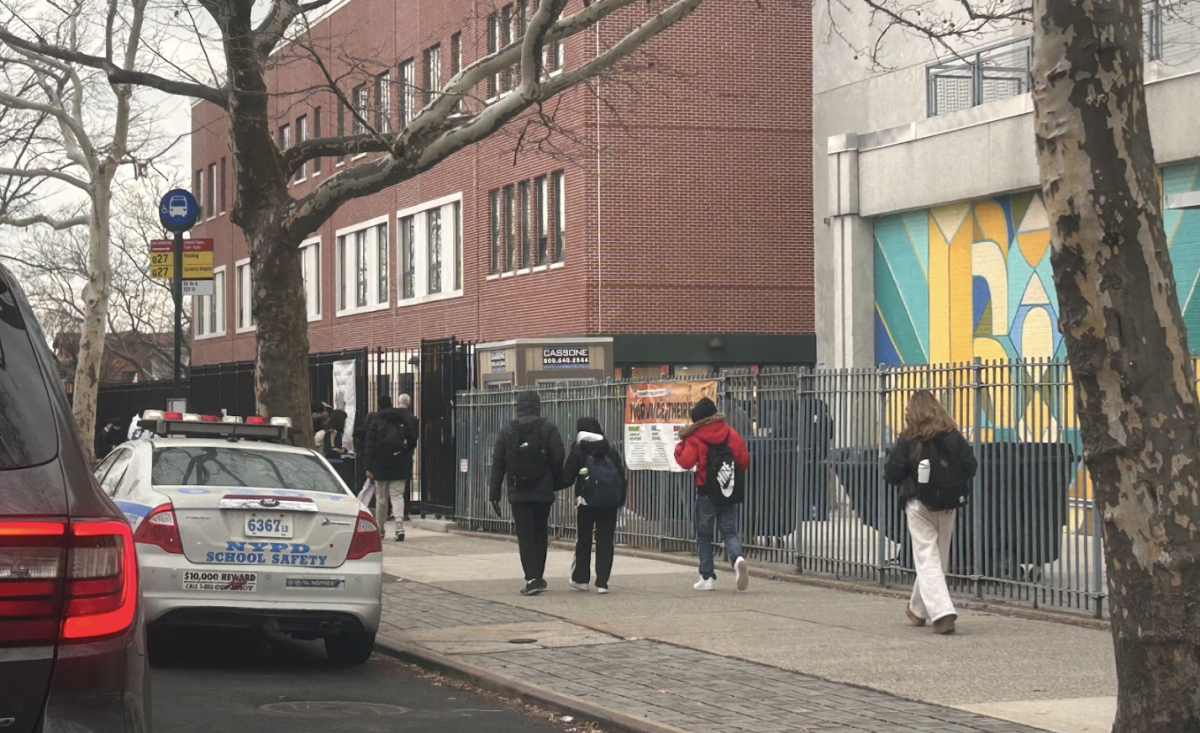
For students of Cardozo, the start of the school day has recently become a lesson in patience. While the school has historically been a “no scanning” building, recent security concerns after the September 2025 incident involving a student found with a loaded handgun have led to the implementation of random metal detector screenings for the foreseeable future. However, a new hurdle has emerged causing friction between these safety protocols and the presence of new, school-issued electronic devices.
After the snow storm on Feb. 22, many who are in the New York City Public School system voiced concerns when Mayor Zohran Mamdani opened schools before the roads and sidewalks were “safe.” After hearing the various concerns of employees, students, and their families, Mayor Mamdani shared that the schools could not go remote on Feb. 24, due to an uncertainty regarding devices for remote learning. Coming off of mid-winter break, both the mayor and the New York City Chancellor argued that if they could not be sure all students had devices, they could not be sure they could participate in remote learning.
As a direct result of this, many schools have been given devices owned by the Department of Education to use both in school and at home. Schools have been mandating students to pick these devices up, specifically to use in school, in coordination with the New York State cell phone ban.
The primary issue that many Cardozo students have with these new devices revolve around morning entry procedures.
Despite school scanning being “random,” the NYPD has primarily focused attention on Cardozo because, according to School Safety Agents, the September incident was a “credible threat.” However, when students have to pass through scanning, they must remove all devices from their bags that are handled by the NYPD School Safety Division.
This new, “multi-step approach,” while thorough, has significantly slowed the morning entry process for all. Students have reported being late to homeroom and first period due to the long lines that wrap around the school’s campus. Specifically during poor weather when students don’t want to take the devices out in the rain or snow, it can become a bigger delay.
The efficiency of the scanners has been called into question by the student body, with many noting that the current system isn’t robust enough to handle the thousands of students who must all be screened within a narrow morning window.
School officials, including Principal Colby, maintain that the goal of scanning is to ensure that, “anything that can be dangerous doesn’t enter the building” without disrupting the school day. Yet, for the students and teachers, the disruption is palpable. Teachers have had to pivot lesson plans as students miss valuable instruction time while waiting in line, or students fall behind when instruction continues on despite their lateness to class.
The NYPD has amped up deployments of officers to the school to assist, but union representatives for school safety officers have pointed out that citywide budget constraints have left them short-staffed by over 2,500 officers, making it difficult to operate enough scanners to move the lines quickly. Oftentimes, Cardozo’s own safety agents that work in the building every day are pulled from their posts to step in and give an assisting hand for scanning.
Many students point out that scanning can be both good and bad. “Safety is very important but at the cost of our instruction time is inexcusable,” said junior Yijia Li.
Assistant Principal Mr. Georgatos, who stands at scanning every morning, had similar sentiments. “I see kids that come in 5-10 minutes early and still can’t get to homeroom on time,” he said. “Particularly in the Annex, having one scanner causes the delay even further.”
Students as a whole have brought the issue of morning entry delays to administration, including students bringing it to the Principal Council, a student program organized by Principal Colby. However, Ms. Colby reiterates that she has “little control” over scanning and when they come to Cardozo, as she finds out when scanning is coming every evening before the following day. This showcases that administration has little to do with when and where the metal detectors come.
Admin, however, says for the time being, students should come prepared. “Take off your belts and try to comply as much as possible to keep it to an in and out process,” Mr. Georgatos said.
As Cardozo continues to navigate this new reality, the community remains divided. While many parents and students support the safety afforded by the detectors, the logistical “bottleneck” created by the combination of high-tech educational requirements and high-security entry protocols continues to be a daily challenge for the students of the school.